The Music of Rebellion: Scoring an Indie RPG

Every role-playing game lives twice: once on the screen, and once in your ears. The Rebellion soundtrack is the second half of that story — the original score Michael Clinesmith wrote for his indie RPG, Rebellion, now on Steam. It’s the music that decides whether a town feels safe, whether a battle feels winnable, and whether you remember a moment long after you’ve put the controller down.
Meet Rebellion: the game behind the music
Rebellion is an indie RPG built by a one-person studio that also happens to be a composer. That combination shapes everything about how the game sounds. When the person writing the code is the same person writing the melodies, the music isn’t bolted on at the end — it grows up alongside the world it’s meant to score.
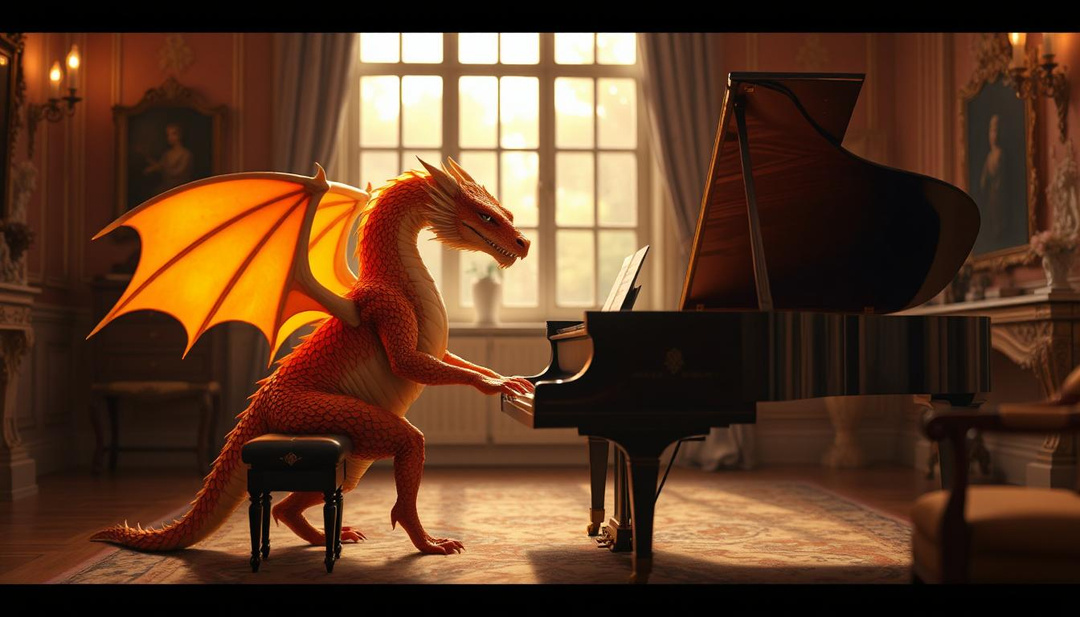
The studio’s mascot, Airy the Dragon, is the friendly face of that world, and a good stand-in for the whole project’s spirit: earnest, warm, a little playful. If you’ve spent any time with the game on Steam, you already know the score is doing quiet, constant work under the surface — setting mood, marking places, and giving the whole adventure a heartbeat.
What an RPG score has to carry
Scoring a role-playing game is a different job from writing a standalone album. A film cue plays once and moves on. A game cue has to loop — sometimes for a very long time — while a player wanders, grinds, backtracks, or simply stops to read. So the music has to be interesting on the first pass and bearable on the fiftieth. That’s a genuinely hard writing constraint, and it’s where a composer’s instincts really show.
Michael’s background is piano-first, and you can hear that discipline in the way the Rebellion music is built: clear melodies, real harmonic movement, nothing hiding behind noise. It’s the same sensibility that runs through his solo album Piano Reveries — pieces like After the Storm and The Joy in Life that earn their emotion through melody rather than volume. An RPG asks that same melodic clarity to do even more heavy lifting, because the tune has to survive repetition and still feel alive.
The other thing a game score has to carry is information. Players learn a world partly through its music. A safe hub sounds one way; a place you shouldn’t linger sounds another. Done well, you stop noticing the cues consciously and start simply feeling where you are. That’s the goal — music as a map you hear instead of read.
Writing themes for places and moments
The strongest game soundtracks tend to work like a small family of themes rather than a pile of unrelated tracks. A motif introduced early comes back later, transformed — slower and sadder in one scene, bright and triumphant in another. It’s the musical equivalent of a character you keep meeting at different points in their life.
That approach comes naturally to a composer who already thinks in miniatures. On Piano Reveries, Michael moves easily between the tenderness of Jade’s Lullaby and For Grandma, the momentum of Dance in D and Race, and the structured, classical shape of the three-movement Sonatina in G. Those are exactly the muscles an RPG score needs: gentle themes for rest, driving ones for motion, and the craft to develop a single idea across a whole arc rather than restating it.
Contrast matters just as much as continuity. A soundtrack that’s all tension exhausts you; one that’s all calm puts you to sleep. The pieces on Piano Reveries show that range in a single album — the quiet of Lovely Night next to the lift of Joyous, the honest struggle of Working Through It next to the ease of Play in the Grass. Pacing that emotional dynamic is the real art of a game score, and it’s a skill built one small piece at a time.
The Soundtrack DLC on Steam
If the music does its job, you’ll want to hear it on its own — outside the game, on a walk or at your desk. That’s exactly what the Soundtrack DLC is for. Alongside the base game, you can pick up the Rebellion Soundtrack on Steam and take the score with you.
Buying the soundtrack is also one of the most direct ways to support a solo developer. When one person writes the code, the story, and the music, every purchase goes straight back into making the next thing. It’s a small gesture that genuinely keeps an independent studio going.
Where to play and listen
If you’re new here, there’s a natural order to explore. Start with the game on Steam to experience the music in context, then grab the Soundtrack DLC to keep it. For the piano side of Michael’s work, listen to and buy Piano Reveries — 22 original tracks that share the same melodic DNA as the game’s score.
You can follow along and hear more on the Endtime Entrepreneurs YouTube channel, and support the studio directly on Patreon. Pianists who want to play the music themselves can find scores on Sheet Music Plus and Sheet Music Direct. And if you’re working on your own project and want a custom score with this kind of warmth, Michael takes commissions through SoundBetter.
A great RPG soundtrack doesn’t ask for your attention — it earns it, quietly, one loop at a time. Rebellion is a small game with a big heart, and its music is a real part of why.
If this resonated, you can listen to and buy Piano Reveries, learn more about the music, or get in touch about a custom score.

 Where to Listen
 Reading, Resting, Relaxing: Living With Piano Reveries
How to actually use Piano Reveries day to day — a warm, gentle solo piano album by Michael Clinesmith made for reading, resting, and quiet afternoons.
 Game Audio
 Inside the Rebellion Soundtrack DLC
A look at the Rebellion Soundtrack DLC on Steam — the original score to Michael Clinesmith's indie RPG, and how to add it to your library.
 Composing
 Hire Michael Clinesmith for a Custom Score
Need original music for your game, film, or video? Composer Michael Clinesmith — creator of Piano Reveries and the Rebellion score — takes custom commissions.